

Dahl.
The recipe that has followed me everywhere.

I open my living room closet, pulling out my chalkboard sign, dried flowers, and rose-colored cheesecloth, grateful that the beds are ready for today’s crisis. I’m prepared for this.
A friend’s power had gone out at her apartment while she was in the wilderness on a week-long canoe trip, resulting in a rancid fridge and a smell so potent she could no longer host her friend who drove into town to celebrate her birthday.
I draped the cheesecloth over my table, doodled a happy birthday sign in chalk, and plopped the dried flowers in a vase to accompany it.
I grabbed some snacks and set them out in the guest room, sweeping the kitchen and turning on the essential oil diffuser before I ran out to my next meeting.
I feel in my element when in crisis, especially when it comes to hosting. Something makes my soul alive when I can create a space of peace amidst the chaos, a home to come to when theirs is far away.
It was in college that I learned the habit of cooking extra food.
There always seemed to be someone needing a meal, and I never regretted making an extra portion. Offering someone good food, as simple as it may be, seemed to be the epitome of love. The herbs seem to whisper, “Hey, look at how flavorful life can be.” The kitchen was my prayer room. A pretty plate seemed to silently speak, “You are taken care of, take your shoes off and stay awhile.”
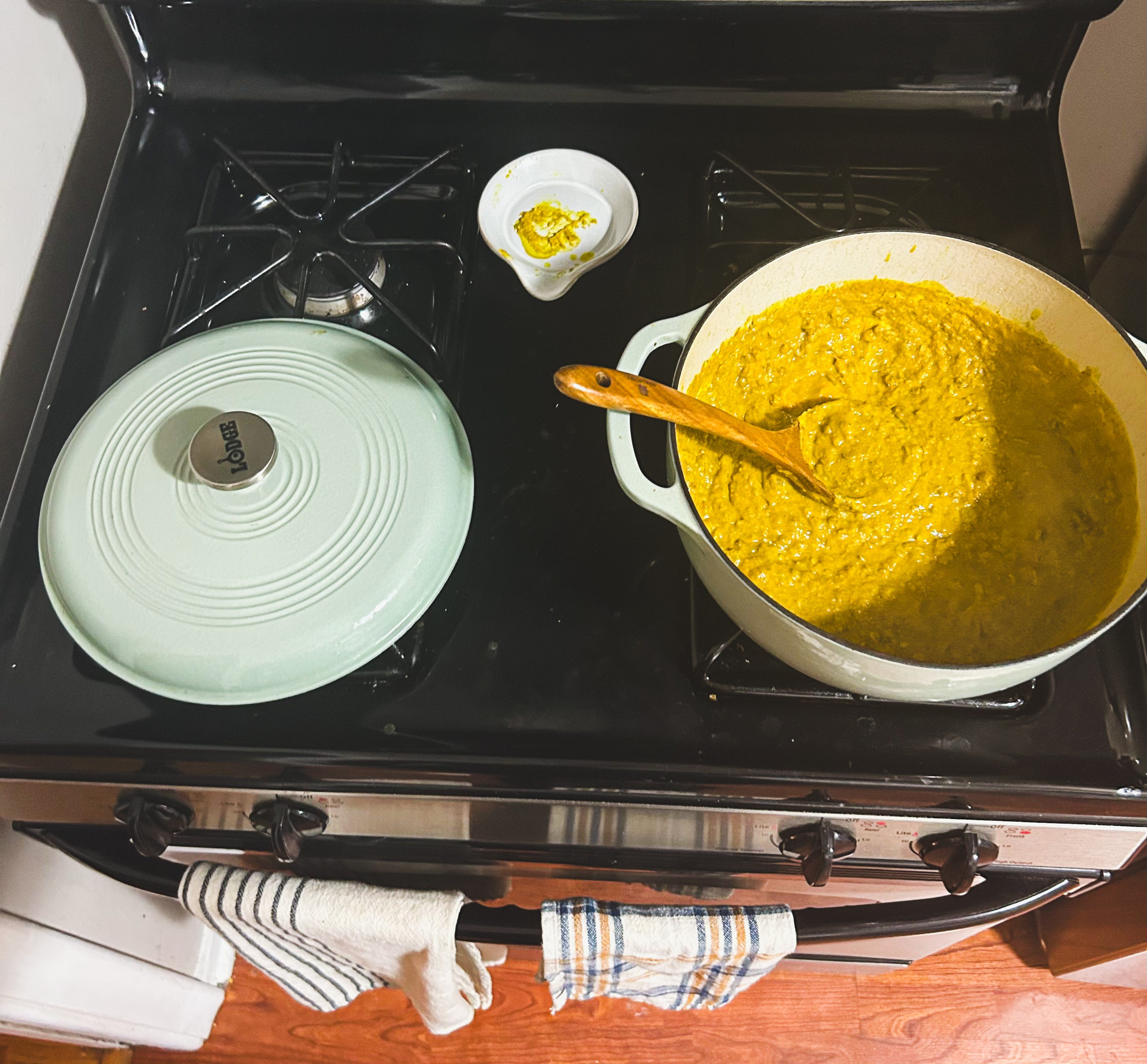
The most common meal I made was Dahl.
I’ll never forget the night I made it for the first time. My best friend told me she had found a new recipe. As I squeezed between the parked cars on the street in Long Beach, CA, I brought my onions, peppers, carrots, and fragrant cilantro from the farmer’s market up the stairs to her tiny apartment. We read the recipe and began chopping, going into the great unknown of a new recipe.
It was just a few simple ingredients, but as it simmered and filled that tiny apartment with aroma of ginger, garlic, and garam masala, our mouth’s watered. We scooped a big bowl over rice and discovered it tasted just as decadent as it smelled.
Ever since, I always keep the ingredients on hand or have some prepped or frozen to heat at a moment’s notice. It never seems to be that someone needs a meal when I have plenty of free time and a surplus of groceries. It’s when I don’t that the need arises. I’ve learned to have the sheets changed on the bed and food hot on the stove to be eaten. Dahl has been the cheapest, simplest, and most delicious way to do so.
Dahl, (sometimes spelled Dal or Daal or Dhal) is a curry-like dish made of lentils, rich in protein, and native to the Himalayas usually served over rice. It freezes well, uses ingredients you probably already have in your pantry, and one batch can feed 6+ hungry humans craving comfort food.
Something about warm Dahl just feels like hospitality. I was broke in college, but I could feed my whole house with a batch for a little under $10. I learned that having Dahl on hand was the way I could always be prepared when people needed a meal last minute, as it often is.
It was a few months later I discovered this treasure trove of a book, “The Gospel Comes with a House Key: Practicing Radically Ordinary Hospitality in Our Post-Christian World” It’s the most beautiful memoir of Rosaria Butterfield: How her anger at God turned to surrender simply through strangers opening up their living room to her. And now she does the same.
She describes her own mason jars filled with lentils as she makes a “daily dahl” for people who come in and out of her house. I was delighted to find someone else who had discovered the secret of this simple comfort food.
While I’m not quite at the point of making dahl daily, I did learn to keep my teapot brewing daily, offering a simple cup of tea to all who entered our door.
And I still do.
And I still make Dahl. It has followed me to every home I have lived in, country I have visited, and kitchen I’ve cooked in. When I’ve been without a stove, housesitting, or living in a dorm, this recipe finds a way to get made. Even without a stove or kitchen, if I can get my hands on a slow cooker or Instant Pot, I make Dahl.
When I was in college I studied the Bible’s definition of home. It was such a transient time in my life and yet the deep desire to create home was like an itch that refused to be ignored. I knew that I would need to learn how to create home “on the go.”
And as I flipped the first pages of my Bible, I discovered what I believe to be God’s definition of home. I don’t believe it’s defined by the perfect minimalist aesthetic home with an ordered walk-in pantry, shiplap walls, or healthy plants that actually get watered.
Home is cultivated wherever you have resources to steward.
There’s a well-known verse in Jeremiah 29 that is quoted often, but the other part isn’t so much.
“Build houses and settle down; plant gardens and eat what they produce. Marry and have sons and daughters; find wives for your sons and give your daughters in marriage, so that they too may have sons and daughters. Increase in number there; do not decrease. Also, seek the peace and prosperity of the city to which I have carried you into exile.”-Jeremiah 29:5-7
This is how God instructed His people to go through exile. They weren’t just living out of suitcases, grumbling about flights getting delayed, or how they were without a land or couldn’t buy their own house.
“Plant Gardens,” He says.
“Build Homes.”
“Have families.”
It’s almost as if he’s giving perspective in the process:
What can you steward? What do you have that you can multiply? You are not in lack.
When we are in the waiting, we don’t often think of what we can give, we think about how we aren’t there yet and how we don’t have enough.
But the reality is God says through His divine power he’s given us, “all we need for life and godliness.” (2 Peter 1:3)
It’s human nature, especially for us Americans, to look at what we don’t have. So often I come to God, full of worry, full of desire, full of complaints about all I don’t have.
And his response?
“What’s in your hand?” (Exodus 4:1-5)
I’ve written about hospitality before. (If you haven’t read it, it’s one of my favorites. You can read it here.) I’ve shown you all my beloved teapot from Goodwill and I’ve shared how my hospitality isn’t glamorous- it’s simple and messy and can be as little as a cup of tea. But I’ve been thinking about how it’s also about preparation.
When you go to the root of the word, Hospitality means, “to create space for healing.”
And creating space for healing, peace, and provision happens way before anyone walks through the door.
It has to happen in my own heart before I ever offer it to another. I can’t steward what I don’t have.
Sometimes my well-intentioned heart is well…not that well-intentioned. It’s as if I’m running marathons but have a heart disease slowly killing me on the inside. On the outside, it can look all selfless and incredible and loving, but inside it’s a desperate grab to receive that kind of love back. It’s pride at its core, wrapped in exhaustion and emptiness. Giving to receive is gross.
I’ve planned many parties and bridal showers and given gifts that had a perfect disguise of self-sacrifice but were absolutely selfish, full of lust for love returned coming from the emptiness of my own heart.
But something has happened when I wake up each day and go to God, an honest cutting open of my insides before Him. He sews me back up, again and again, each stitch filled with love and peace, and purpose and healing. I have something to give freely. Because I’m whole again.
I have to do this day after day. Each day seems to bring new stitches. I wish it were a one-time process or even a once-a-week process, but it’s not.
On this day, when the chaos came, I was ready. Yes, the beds were made, snacks were in the pantry, and birthday decorations were easy to throw together, but most importantly, my heart was prepared.
So as the girls stayed that night and I helped sanitize her fridge the next day, I was delighted. I felt a little bit of those words Jesus once said, “It is more blessed to give than to receive.” (Acts 20:35)
I didn’t need anything in return.
My floors weren’t clean, I had a pretty empty fridge, and just one hour to help sanitize her kitchen over my lunch break, but I gave what I had.
I believe that raw, unpolished hospitality is the kind that heals. Clean bathrooms and gourmet meals are extravagant and lovely, but not prerequisites for inviting people in.
I think there is one though:
A heart ready to give.
I think inviting people into your home is a process of endless preparation. There are practical things like making the guest bed so it’s always ready, 10-minute clean-ups to keep things decently clean, and keeping lentils stocked in your pantry, but it’s mainly an art of the heart.
Each morning you sign up again to let people into your mess, to let in His peace and healing, and offer it to others.
I have to keep stocking lentils in my pantry and there never seems to be enough coconut milk. But I’m learning how to keep these constant.
I go to the Source.
This Dahl recipe is close to my heart because through making it a million times I think I’m finally cracking open the can of freely giving as I open the coconut milk. I’m learning to sit in the presence of God as I let it simmer on the stovetop. I’m learning how I constantly have to restock the love in my own heart just as often as I have to buy more lentils.
And I have learned that no matter where I am, I have this to steward and therefore I can find home:
A heart filled that can freely give.
This is the Dahl recipe I have used for the last 6 years. It’s savory and a little sweet. It is vegan and gluten-free and dairy-free and sugar-free and whatever else people can’t eat these days which makes it a great default when you need to cook for a crowd.
Maybe you’ll love it and adopt it as your own, or maybe you won’t. For me, I’ll always be grateful for how this little dish taught me so much through just a few simple ingredients.
For the One,

P.S.
👩🏼🍳 Make it yourself. Cook this Red Lentil Dahl Recipe from Ela Vegan.
💬 Comment how it went OR share your go-to recipe for hosting. I’m definitely in need of more.
Enjoy.

I live in a place where dal and rice is eaten every day. I loved everything about this article and will reread it when it’s not my bedtime here ❤️
This piece is so lovely and reminds me of my mother! Just replace Dahl with rice and beans. She could feed so many unexpected mouths in any given day. Thank you for evoking that memory!